
AAA SOLID FOUNDATIONS
TELEPOST ADJUSTMENTS
NOTE
At this time, AAA Solid Foundation is no longer offering telepost adjustments or replacements as a standalone, singular service.
At AAA Solid Foundation, our primary focus remains delivering comprehensive, long-term structural solutions for your home.
Due to our current high workload with full foundation repair, wall bracing, exterior waterproofing and interior water management projects.
We are no longer offering telepost/jack post adjustments or replacements as a standalone, singular service.
However, telepost service and adjustments remain fully integrated into our complete foundation repair packages. If your home requires telepost work as part of a larger structural stabilization or repair project, our team continues to provide this service.
We appreciate your understanding and look forward to protecting your foundation.
Learn how to adjust a telepost yourself below.

ASK AN EXPERT
If you still have questions about any of our services, please feel free to ASK AN EXPERT or review our FAQ section.
CAN I ADJUST A TELEPOST MYSELF?
Adjusting a telepost (also known as a jackpost or screw jack) is a critical task.
It’s usually done to level sagging floors, but because you are dealing with the structural load of a house, doing it too fast can crack drywall, jam doors, or cause structural damage.
The golden rule of adjusting a telepost is patience. You are moving a house, and the house needs time to settle and adjust to its new position.
WHAT TOOLS ARE NEEDED TO ADJUST A TELEPOST?
Before you begin, ensure you have the right tools on hand:
-
Heavy-duty adjustable wrench or pipe wrench (sized for the telepost’s adjustment nut).
-
Laser level or a long spirit level paired with a straightedge.
-
Tape measure to track your progress.
-
Pen and paper (or your phone) to log your adjustments and dates.
-
Safety gear: Safety glasses and a hard hat (highly recommended when working under heavy structural loads).
Important Notice
Adjusting a telepost affects the structural integrity of your home and carries inherent risks. By reading or using this guide, you agree to our Legal Disclaimer & Terms of Use. If you do not agree, do not attempt these adjustments.
STEP ONE
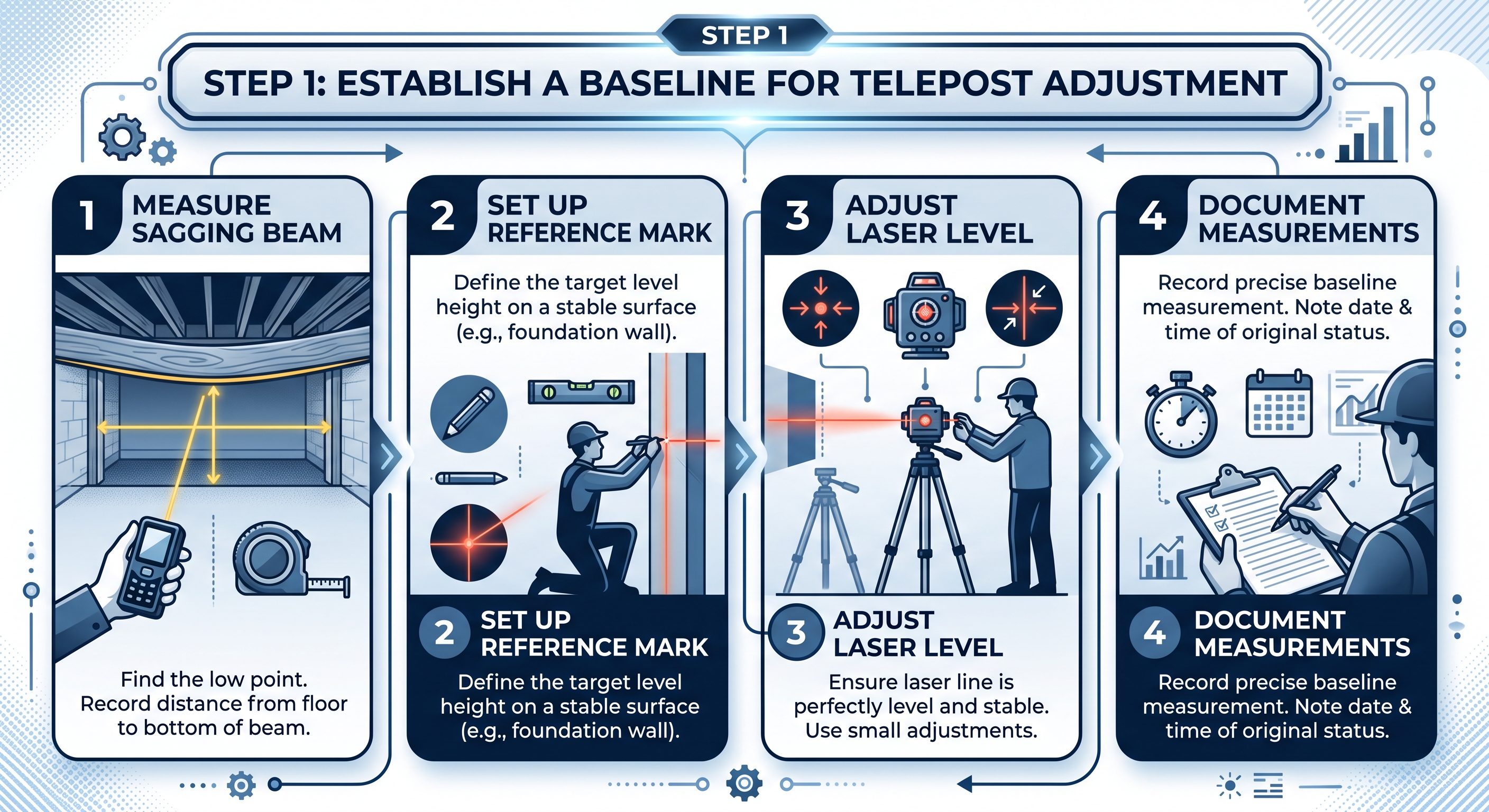
Establish a Baseline
Before any adjustment begins, you must determine exactly how much the structure needs to move. This step is about precision measurement.
Use a professional self-leveling laser to project a reference line. This established line allows you to measure the exact distance to the sagging beam using a tape measure. Log this baseline measurement. It is your only reference for tracking progress in increments as small as 1/16 of an inch.
STEP TWO
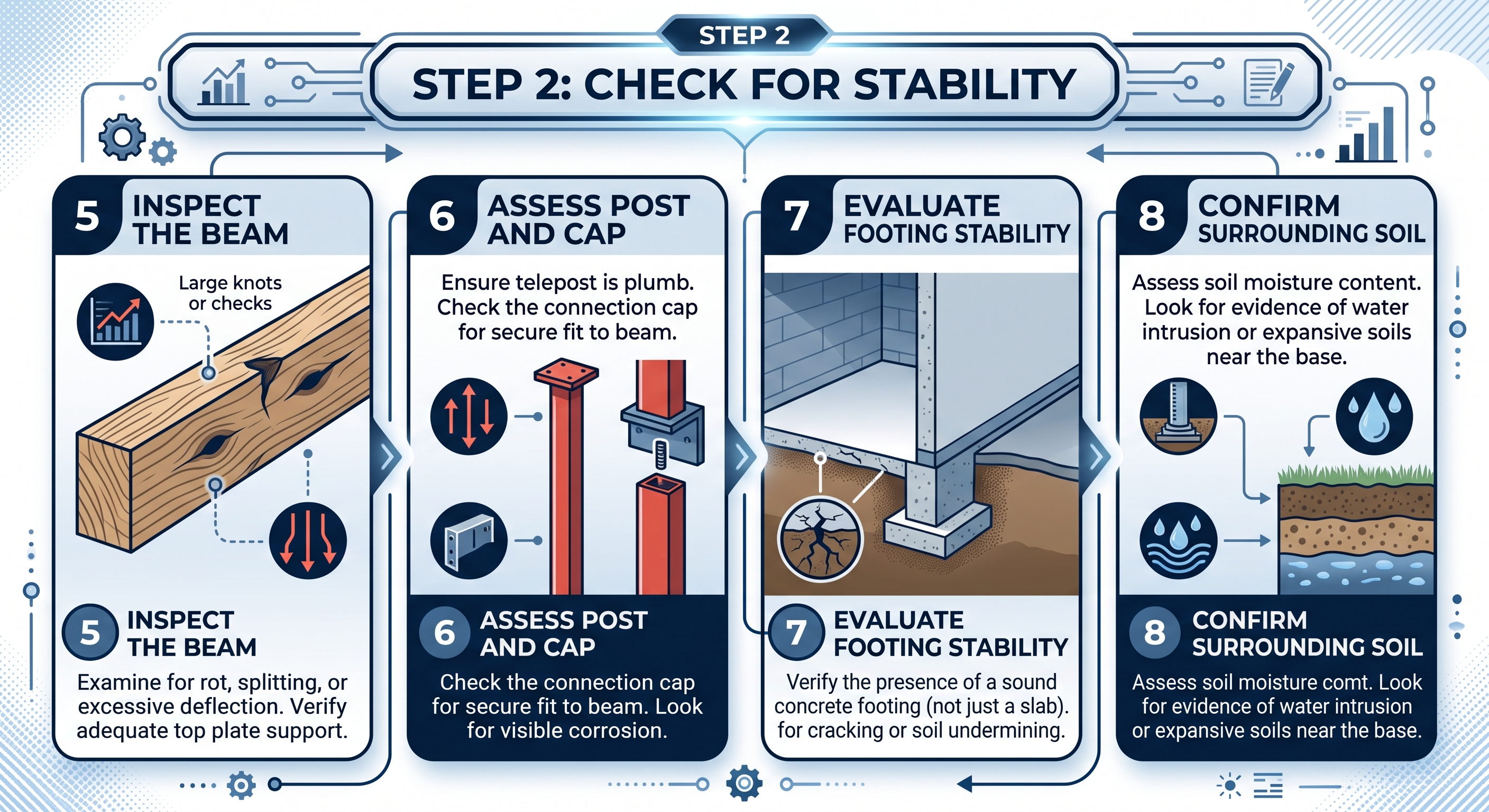
Check for Stability
STEP THREE
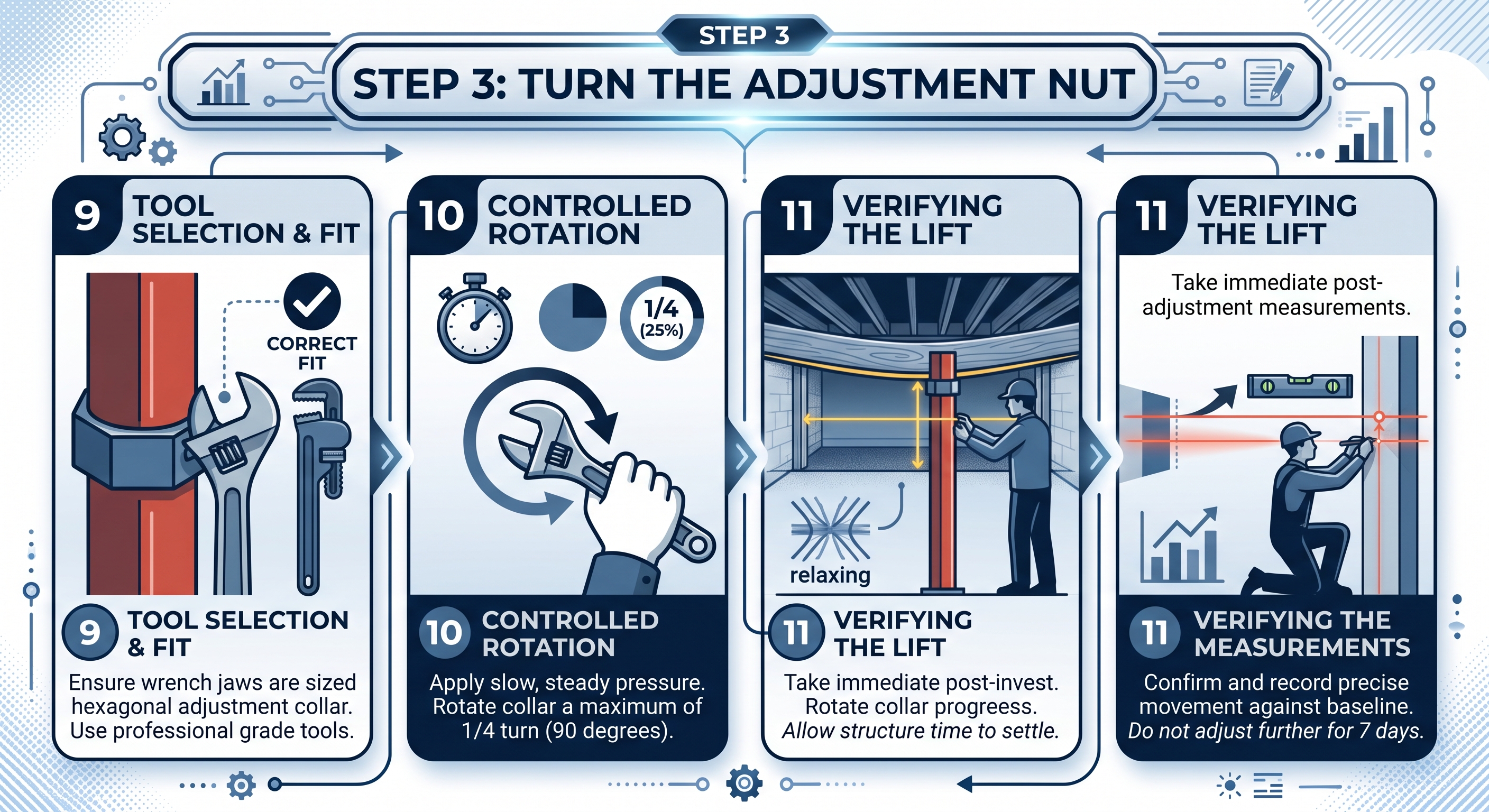
Turn the Adjustment Nut
STEP FOUR
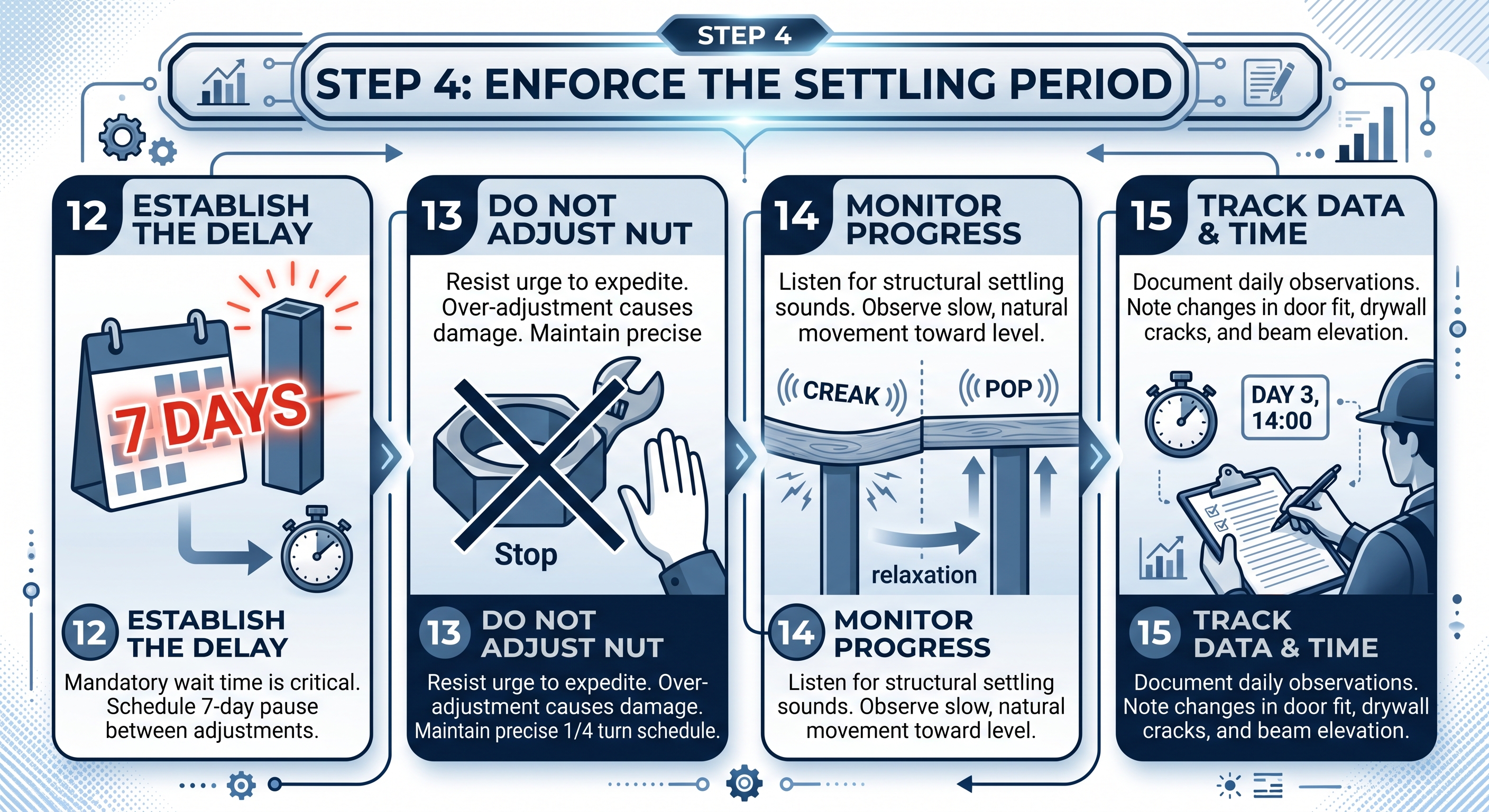
Enforce the Settling Period
As the graphic shows, a delay of at least 7 days is required before the next adjustment. This time allows the entire wood framing system above—joists, subfloors, and drywall—to slowly relax and redistribute the new structural stress.
Attempting to lift too quickly is the primary cause of cracked drywall and jammed doors.
STEP FIVE
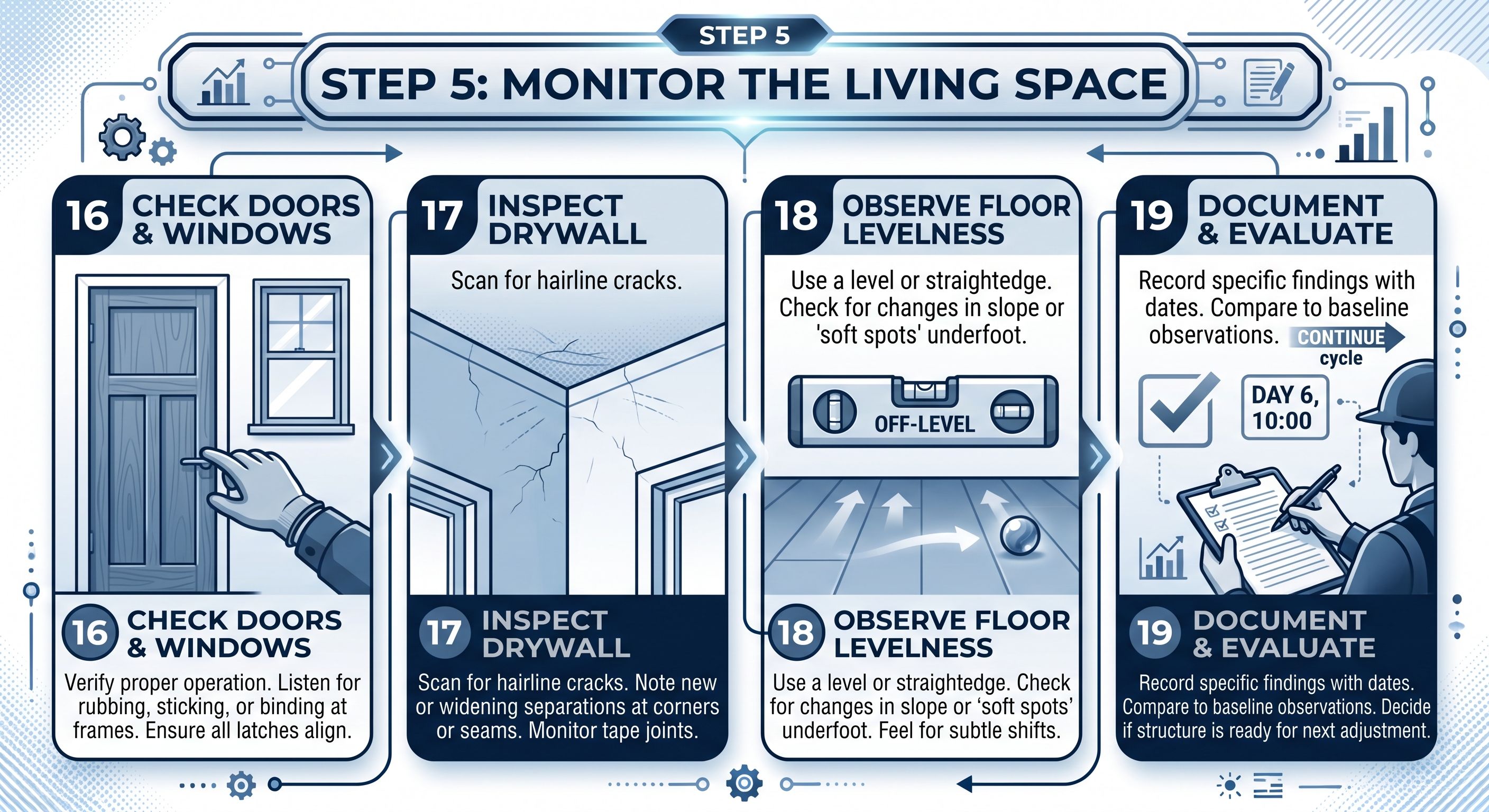
Monitor the Living Space
STEP SIX
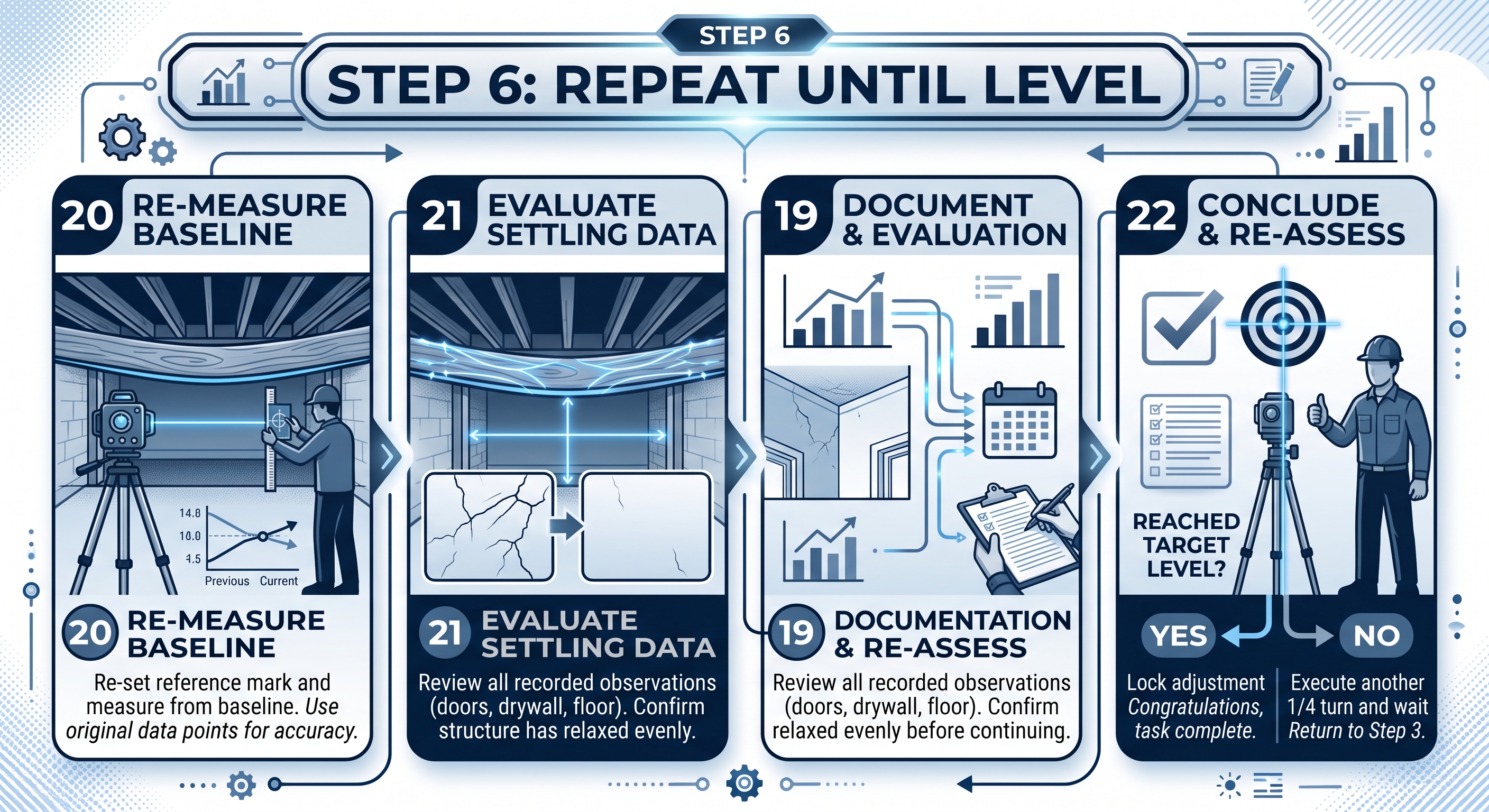
Repeat Until Level

WHAT IS A TELEPOST?
A telepost is the adjustable steel column extending from the concrete floor to the underside of the main floor beam.
Teleposts transfer the weight load from the main floor to the foundation pad. There may be multiple teleports installed. It will depend on the size of the home, and the span of structural beams.
Placing teleposts in engineered locations to pick up the weight of the floor(s) above.
If you have teleposts installed, they can be carefully adjusted to help level upper floors if your foundation has sunk.
Key Functions of a Basement Telepost:
Supporting Load-Bearing Beams
Teleposts, placed under load-bearing beams, help transfer the weight from the upper floors. Down to the foundation. This provides crucial support to prevent structural movement or sagging.
Adjusting for Structural Stability
Most teleposts are adjustable. Allowing them to be raised or lowered to ensure proper alignment as a house settles over time. This helps maintain a stable and level floor structure.
Reducing Floor Deflection
Teleposts prevent floor deflection. Which is the bending or sagging of floors under heavy loads. By supporting the beams, teleposts help maintain the level of the floor. Preventing cracks in walls, ceilings, or floors above. Adjustments also help doors and windows from becoming hard to open.
Supporting Remodeling or Repairs
Teleposts can be temporarily installed during renovation or repair projects. When and where extra support is needed. Such as removing or altering a wall or replacing parts of the structural beam.
What Does Adjusting A Telepost Do?
Adjusting the telepost in your home can:
- Level floors on the upper levels
- Prevent floor squeaks
- Help unstick doors and windows
- Minimize cracks in walls
CAUTION
Never adjust support teleposts by large amounts. Adjust them by small amounts at a time. , especially on newer homes.
Adjusting a telepost too quickly or improperly may cause large cracks to appear in walls. Flooring also may become loose or squeaky.
A general rule of thumb is to do adjustments no more than one-half a turn at a time
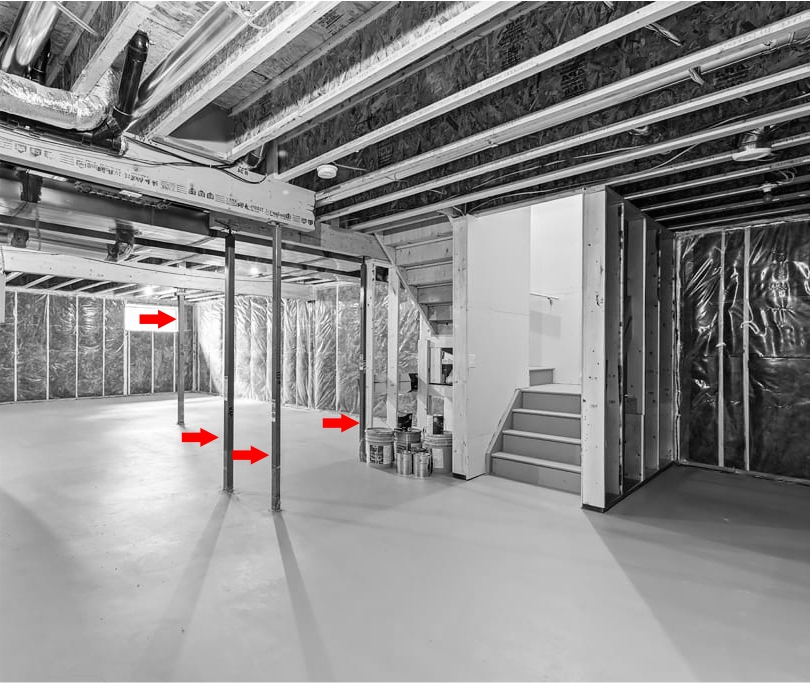
The image shows 4 visible teleposts, marked with a red arrow. Depending on the size of your home, you may have several teleports or one or possibly none. But if you have purchased a home that has a finished basement, the telepost may be hidden inside a finished wall or a decorative covering such as wood or drywall.
LEGAL DISCLAIMER & LIMITATION OF LIABILITY
REQUEST A BASEMENT
FOUNDATION REPAIR ESTIMATE
If your home signs of water seepage, uneven floors, cracks in walls or basement floor, gaps between floors and walls or shrinking soil around the foundation.
We also provide Free Quotes for Sidewalk & Driveway Replacement, Garage Pads, and Patios.

306 352 1826

AAA Solid Foundation Service Area
AAA Solid Foundation Repair provides foundation repair in a 200 km radius around Regina.
Assiniboia
Davidson
Emerald Park
Estevan
Fort Qu'Appelle
Gravelbourg
Indian Head
Melville
Moose Jaw
Weyburn
White City
Yorkton

AAA Solid Foundations is Licensed to work in Saskatchewan and is fully insured.
We are in good standing with the Saskatchewan Workers Compensation Board.
MAILING ADDRESS
AAA Solid Foundation Repair Ltd.
PO Box 37052
Regina, SK
S4S 7K3